
See through document fraud with Document AI Enhanced Fraud Detection



On April 2, 1796, a full house packed the Drury Lane Theatre in London, eager to witness the first showing of a newly discovered Shakespeare play. The problem was that William Henry Ireland wrote the play, Vortigern, and the entire production was a hoax.
Although there was some controversy before opening day, several experts reviewed the manuscript and supporting documents and confirmed that the play was a long-lost Shakespeare original. Crowds weren’t convinced, and there wasn’t a second showing.
230 years after Ireland’s forgery, fraudsters are more likely to falsify supplemental documents than ever before. And just like Ireland’s Vortigern, these documents can go undetected, even if there’s an expert review.
Threat actors can create convincing forgeries en masse
Documents are widely available and can be used to verify users’ attributes, including address, tax information, income, and insurance status. But they’re also a significant source of fraud.
Supplemental document fraud can be particularly challenging because:
Authentic examples are readily available: People often recreate or alter official documents they received. They can also easily find official example documents online.
Documents don’t follow a standard format: While documents of the same type typically contain the same basic information (e.g., name, address, and account numbers), organizations generally structure the information differently.
Many documents lack robust security features: Unlike government IDs, supplemental documents generally don’t include holograms, stamps, security ink, or other features that make them difficult to forge.
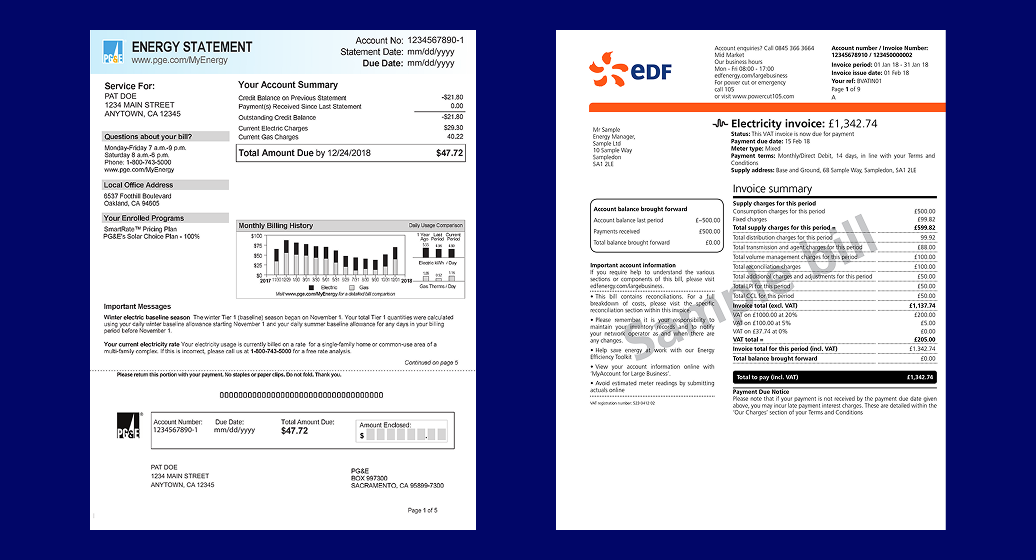
Example energy statements from PG&E (left) and EDF (right).

With just a few easily accessible tools, even unsophisticated fraudsters can create fake documents that look authentic.
In 2025, Persona’s Document AI helped companies like Twilio, Wealthsimple, Travelex, and DolarApp process millions of supplemental documents. Recently, we’ve observed that fraudsters are increasingly:
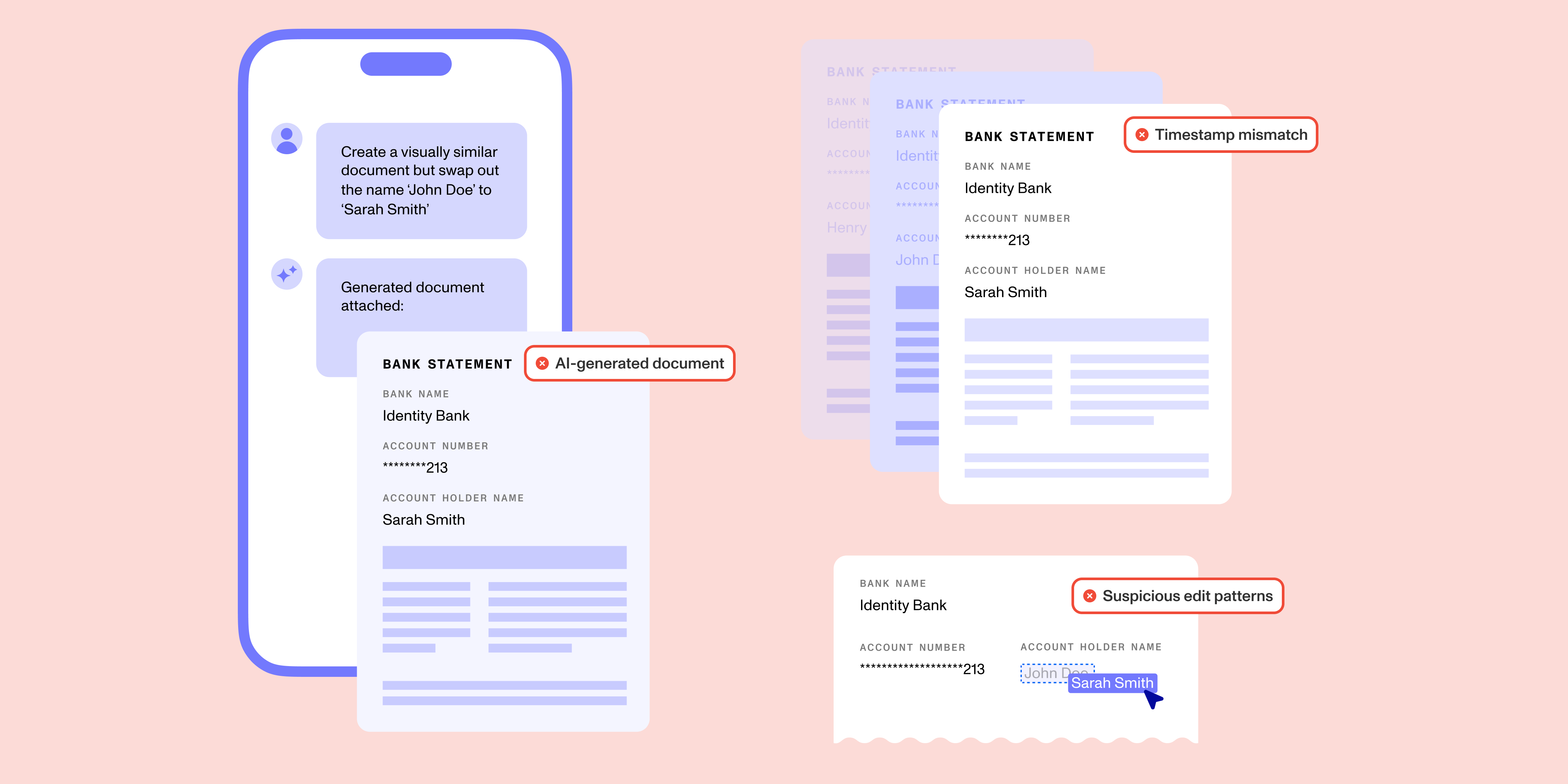
Modifying documents: Fraudsters often use PDF or photo editors to change authentic documents. Examples include using annotations to replace authentic names, addresses, or account numbers with falsified information. They might do this to alter their otherwise legitimate documents, or to create a document that supports a synthetic identity.
Creating documents: As AI models improve, fraudsters increasingly use them to create authentic-looking documents from scratch. GenAI documents are sometimes good enough to avoid visual detection. Because they’re generated, these documents won’t trigger tampering-related indicators.
Scaling attacks: Fraudsters also use templates and AI to alter and create thousands of documents. They repeatedly test defenses to figure out what works and scale attacks.
If you’re a financial institution, fintech, or marketplace, there’s a good chance you’re dealing with these types of attacks.
Stop the latest fraud attacks with Document AI Enhanced Fraud Detection
While the new wave of document fraud is concerning, you can protect your business against AI-generated documents, tampering, and scaling fraud attacks with Document AI Enhanced Fraud Detection’s unique indicators and document viewer.
More risk indicators for greater insight
Go beyond traditional inspection methods by checking documents for hundreds of new risk indicators, including:
Visual anomalies: Detect suspicious pixels, GenAI artifacts, and other alterations that investigators can’t see on their own.
Suspicious metadata: Expose PDF and image editor use, the presence of inconsistent or suspicious fonts, timestamp mismatches, and more
Content inconsistencies: Highlight inconsistencies in names, account numbers, and other fields. These inconsistencies can be signs of tampering or template usage.
Contextual anomalies: Flag areas where information in the document doesn’t align with expectations based on the document type or region, such as an incorrect calculation or currency.
Scaled fraud indicators: Identify previously submitted documents and altered templates.
You can also customize the risk levels and definitions to your specific needs, and tailor your fraud defenses to your business’s goals. To keep you protected against evolving threats, Persona continuously refreshes the indicators based on the latest fraud vectors and attempts.
A powerful and intuitive review surface
Document AI automatically detects the majority of fraudulent attempts, and organizations route the complex edge cases to investigators.
Usually, reviewers are often forced to jump between multiple tabs, tools, and data sources to get the insight they need. Given that some documents can exceed 100 pages, it’s easy to see how reviewers can get overwhelmed.
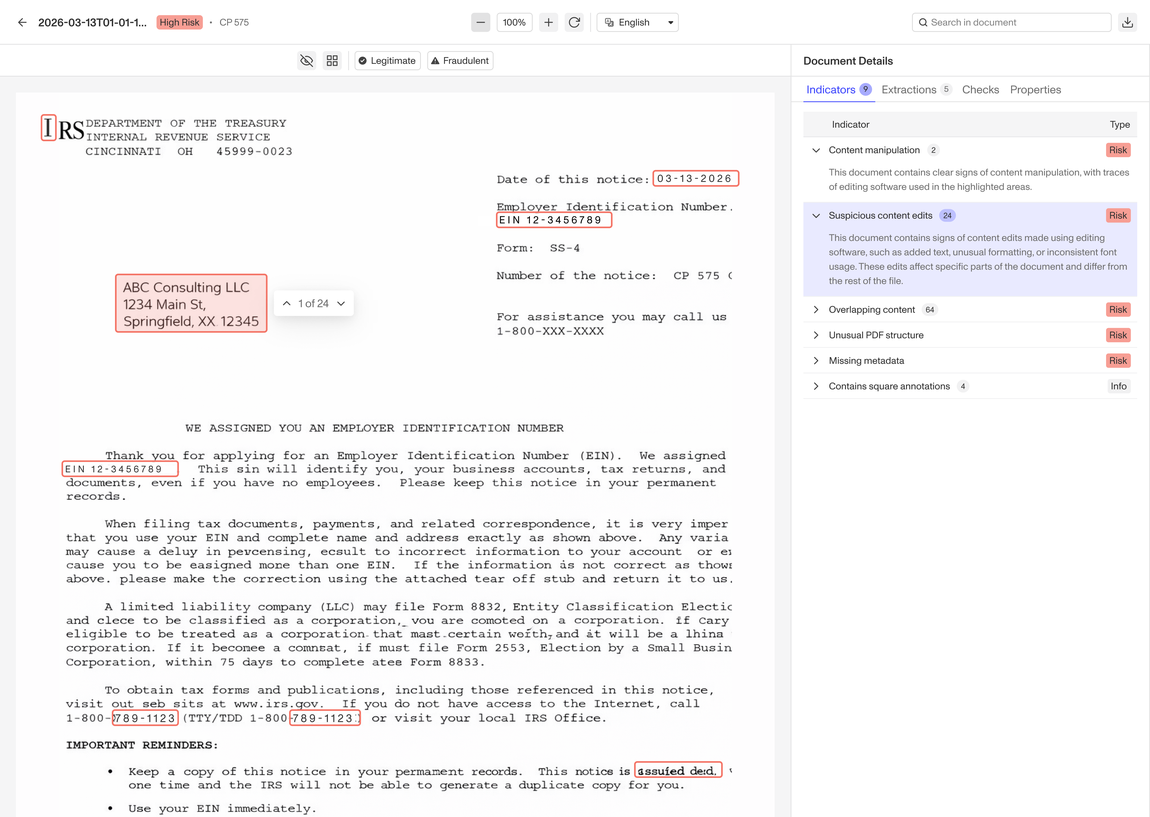
To help investigators make accurate fraud designations efficiently, Document AI’s document viewer highlights risk indicators on the document and layers metadata with extracted information in a unified, intuitive interface. Reviewers have everything they need in one place.
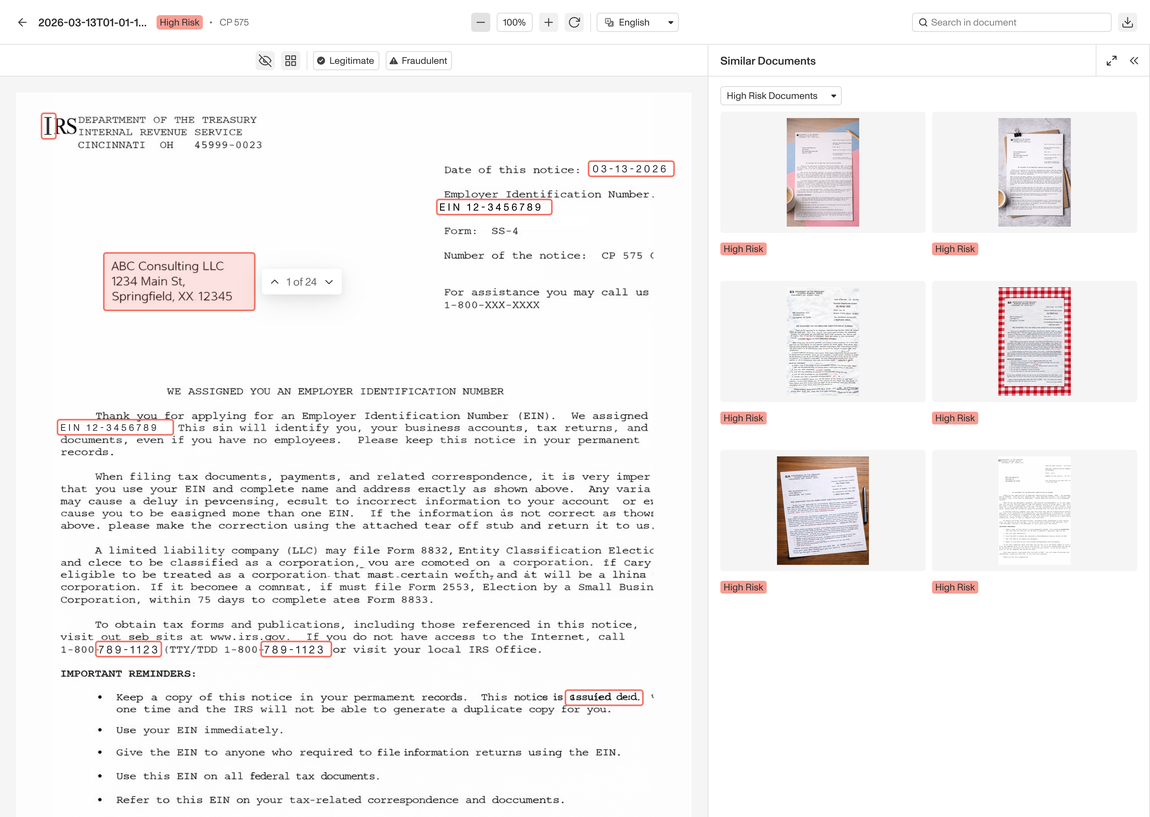
Additionally, fraud teams can complete reviews more quickly and accurately if they have side-by-side references. The Document AI viewer accomplishes this by providing reviewers with examples of similar authentic and fraudulent documents.
Combine Enhanced Fraud Detection with Persona’s holistic fraud suite
We’ve long advocated for taking a holistic approach to fighting deepfakes, fake IDs, synthetic identities, and other fraud attacks. Document fraud is no different. Incorporating different types of risk signals and checks into your defenses can help you detect more fraudulent documents and fraudulent attempts involving legitimate documents. These include:
Environmental signals: Collect passive signals such as device fingerprint and IP address, behavioral information, and other environment-level signals to add assurance without increasing friction during document submissions and user onboarding.
Population-level signals: Use population-level checks to uncover connections between accounts, devices, and other attributes. For example, check whether someone submits a document from a device that was previously associated with fraud. Graph, Persona’s link analysis tool, uncovers these connections in real time to help you make well-informed decisions.
Additional verification checks: Use a risk-based user flow to require additional verification checks as needed. These can include government ID, database, and selfie checks that increase assurance and allow you to cross-check information extracted from documents.
The confluence of structural, societal, and technological shifts is increasing online fraud. In the midst of uncertainty, it’s important to understand the fraud you face, define your strategy, and deploy an approach that’s tailored to your business. To see how Persona can help you every step of the way, reach out to a member of our team today or sign up for a free demo.
The information provided is not intended to constitute legal advice; all information provided is for general informational purposes only and may not constitute the most up-to-date information. Any links to other third-party websites are only for the convenience of the reader.